My overarching goal is to understand cognition in naturalistic environments using computational models. I focus on sensorimotor integration, examining how the brain generates predictions, detects prediction errors, and uses these errors to update behaviour. To investigate these processes, I combine virtual reality, mobile EEG, motion tracking, and computational modeling.
My dissertation focuses on multisensory integration during naturalistic navigation in virtual reality, under the supervision of Bob Wilson. This work investigates how people combine visual and body-based cues, and how they transform spatial estimates into actions as a closed-loop control. Read more in my review in Nature Reviews Psychology, our paper in Neuropsychologia, and our recent preprint on bioRxiv.
I also study how people learn to control robotic arms during teleoperation with the da Vinci Surgical System. This project uses control theory to model motor skill learning in human–robot interaction. Read more in our work in npj Science of Learning.
My work has been recognized by the Link Fellowship Honorable Mention, the Society for Neuroscience Trainee Professional Development Award, and the University of Arizona Outstanding Research Award in Cognitive Science. My research has been supported by the Psychology Interlab Grant at Georgia Tech, University of Arizona Research and Project (ReaP) Grant, the SensorLab Seed Grant, and the OpenAI Researcher Access Program.
News
2026.10
Our work "Do Simulated Users Reveal Behaviorally Observable States During Human–LLM Joint Decision Making?" accepted by SocialAgent @ NeurIPS 2026. See you in Atlanta!
2026.09
Our work, “Human Learning Dynamics During Teleoperation of Surgical Robots,” has been accepted by SurgTwin @ IROS 2026. See you in Pittsburgh!
2026.08
Teaching my first in-person course Engineering Psychology at Georgia Tech!
Research Interests
 |
Control theory |
|---|---|
 |
Virtual reality |
 |
Multi-sensory integration |
Education
 |
PhD in Psychology Georgia Institute of Technology | 2024 - Present |
|---|---|
 |
MA in Psychology University of Arizona | 2022 - 2024 |
 |
Honours BSc in Psychology University of Toronto | 2016 - 2020 |
Research Roadmap
Closed-loop control across sensory modalities.
Featured Publications
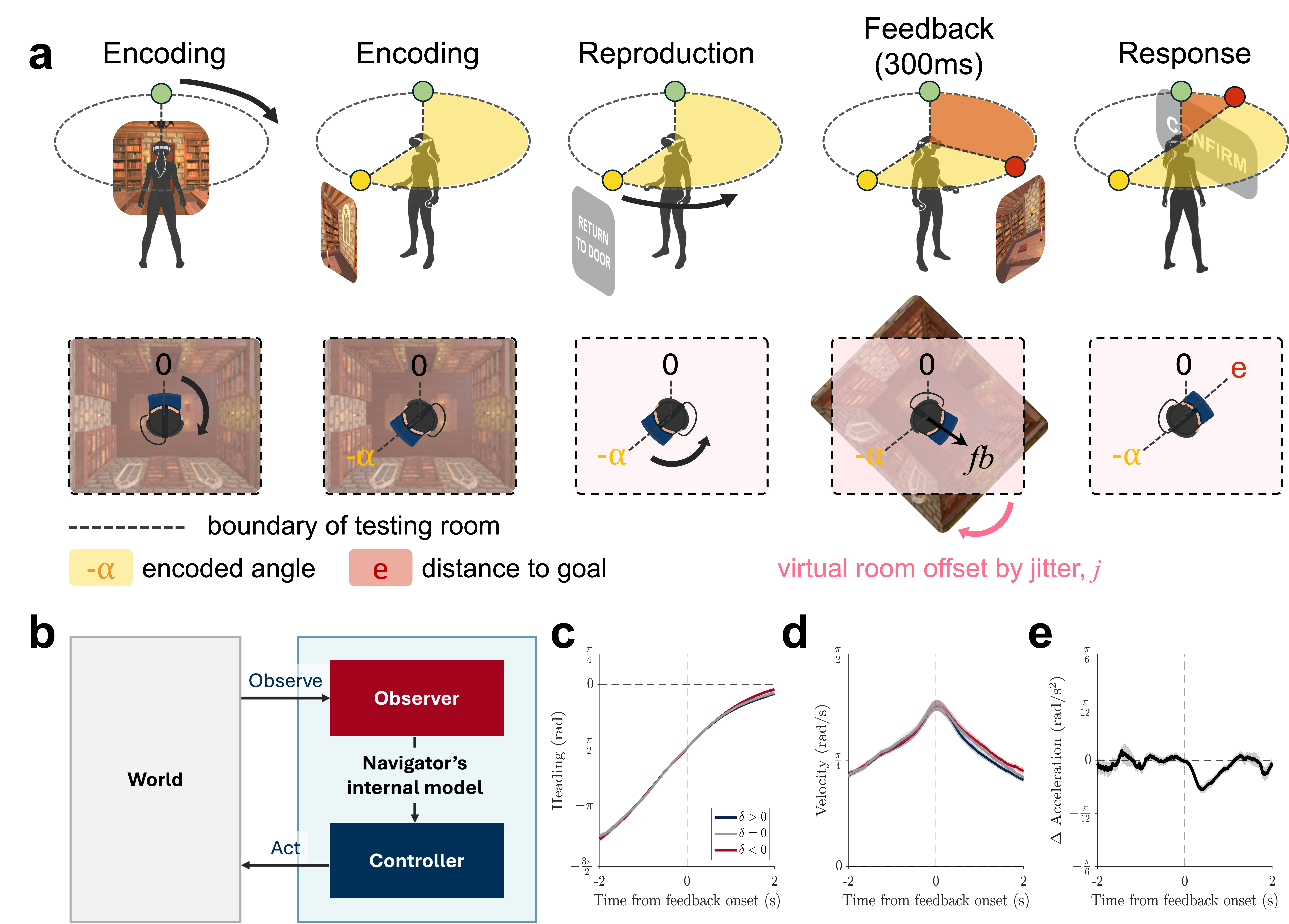
, Vishwanath, A., Du, Y. K., Watson, M. F., Asiri, O., Ekstrom, A. D., & Wilson, R. C. (Under review). Modeling the journey as well as the destination: a control theory account of rotational navigation.
Closed-Loop Control in Human Navigation
We investigate how people turn spatial estimation into action during navigation. By combining virtual reality experiments with a control-theoretic model, we show that visual prediction errors trigger rapid movement corrections and that navigation is best understood as a continuous feedback-control process. This work connects theories of motor control and cue combination during navigation.
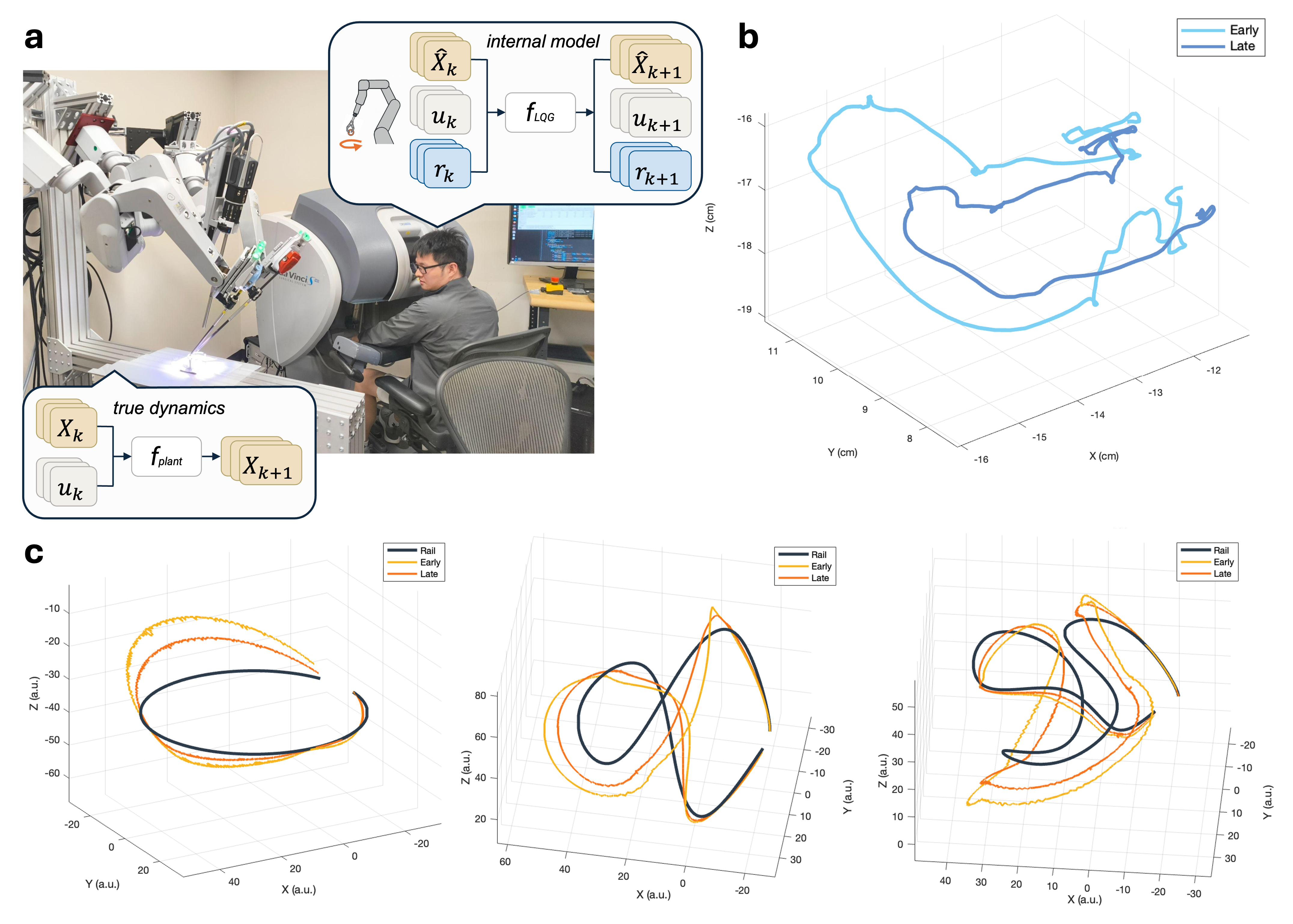
, Cai, Y., Li, M., Chen, Y., & Wilson, R. C. (2026). Human learning dynamics during teleoperation of surgical robots. npj Science of Learning.
Learning to Control Surgical Robots
We investigate how people learn to operate surgical robots and how interface design affects learning. By combining teleoperation experiments with computational modeling, we show that a simple control-theoretic model captures human skill acquisition and transfer. These findings provide a foundation for designing curricula that better support surgical training.
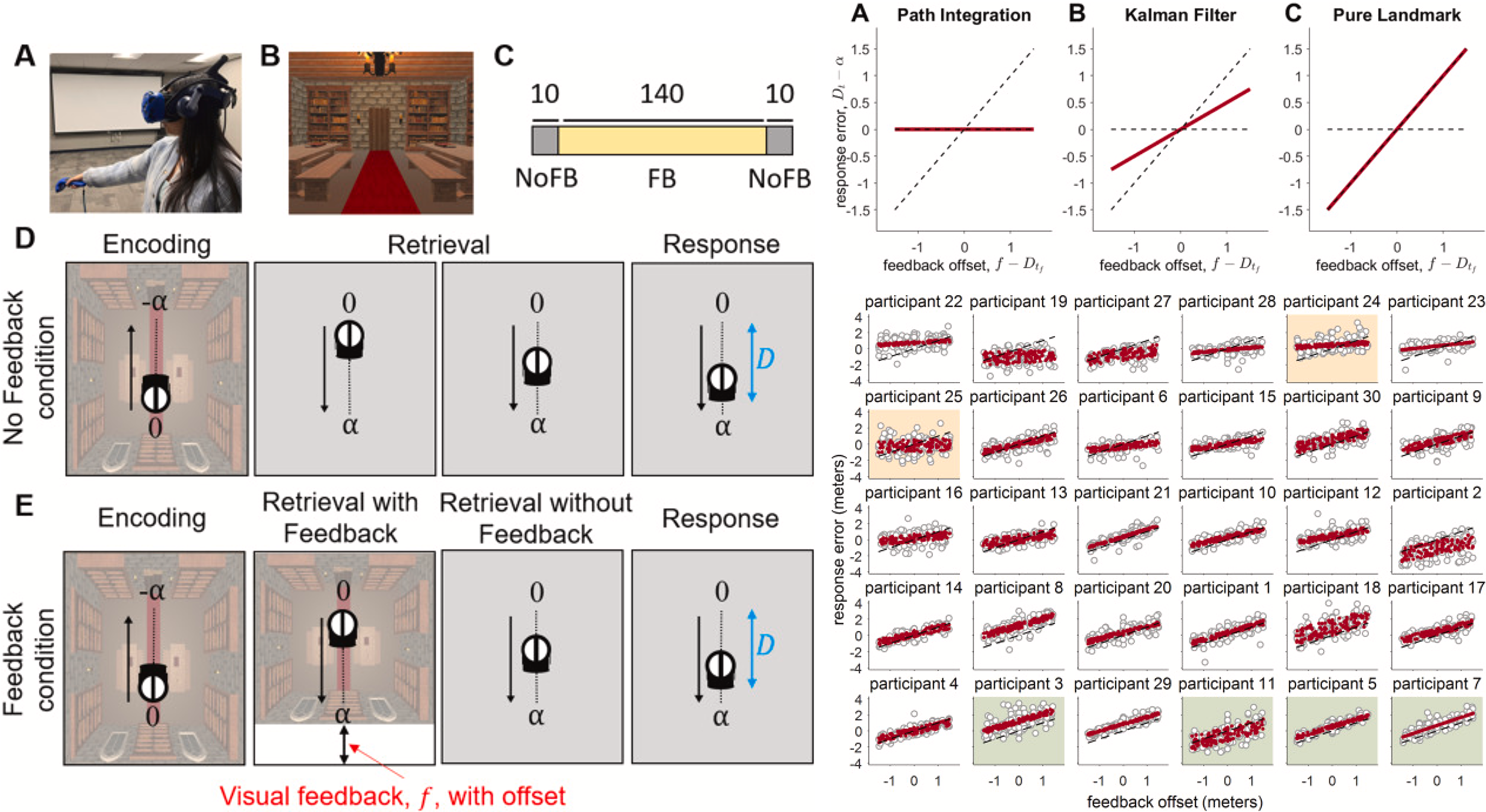
Vishwanath, A., Watson, M. F., Gin, M. K., Markham, D. C., , Du, Y. K., Ekstrom, A. D., & Wilson, R. C. (2025). Bayesian cue combination best predicts straight-line distance estimation with translated visual landmarks. Neuropsychologia.
Bayesian Cue Combination in Distance Estimation
We investigate how people combine self-motion and visual landmarks when estimating distance. Using immersive virtual reality and computational modeling, we show that most individuals weight these information sources according to their uncertainty, consistent with Bayesian cue combination. These findings help explain why people navigate differently under ambiguous sensory information.
Moments
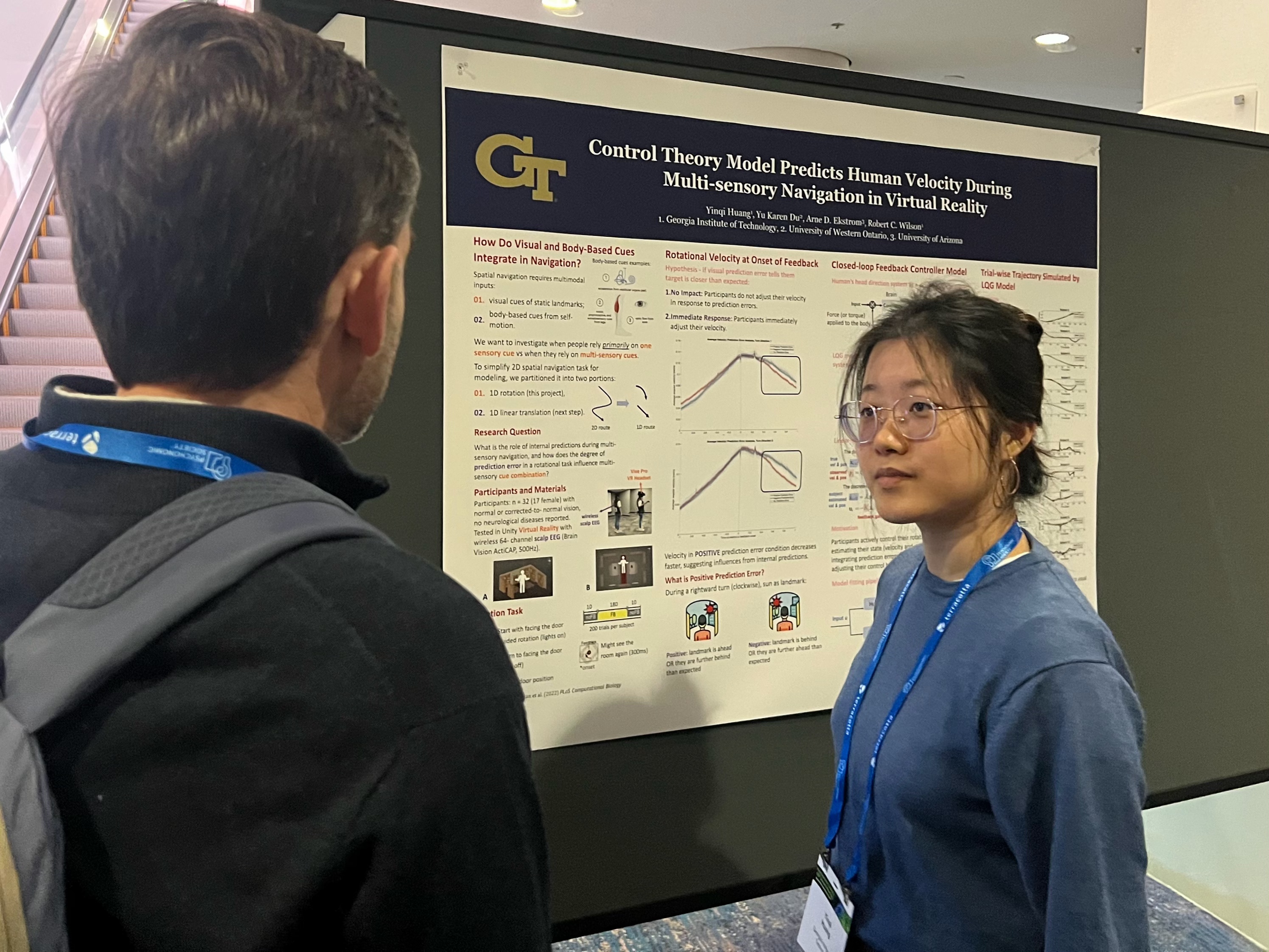
Poster presentation at Psychonomic Society in New York.
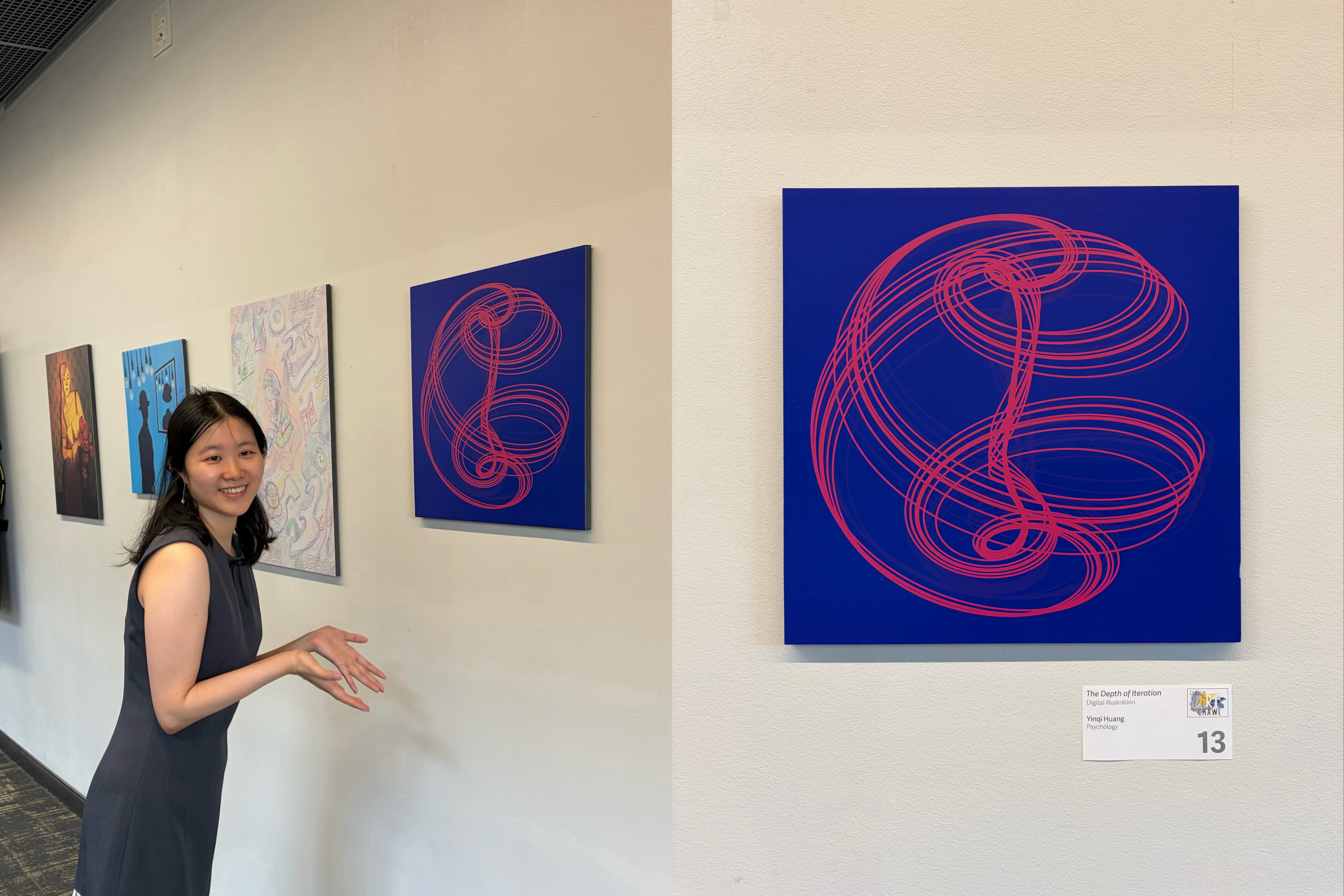
Artwork exhibition at the Clough Commons, Georgia Tech.
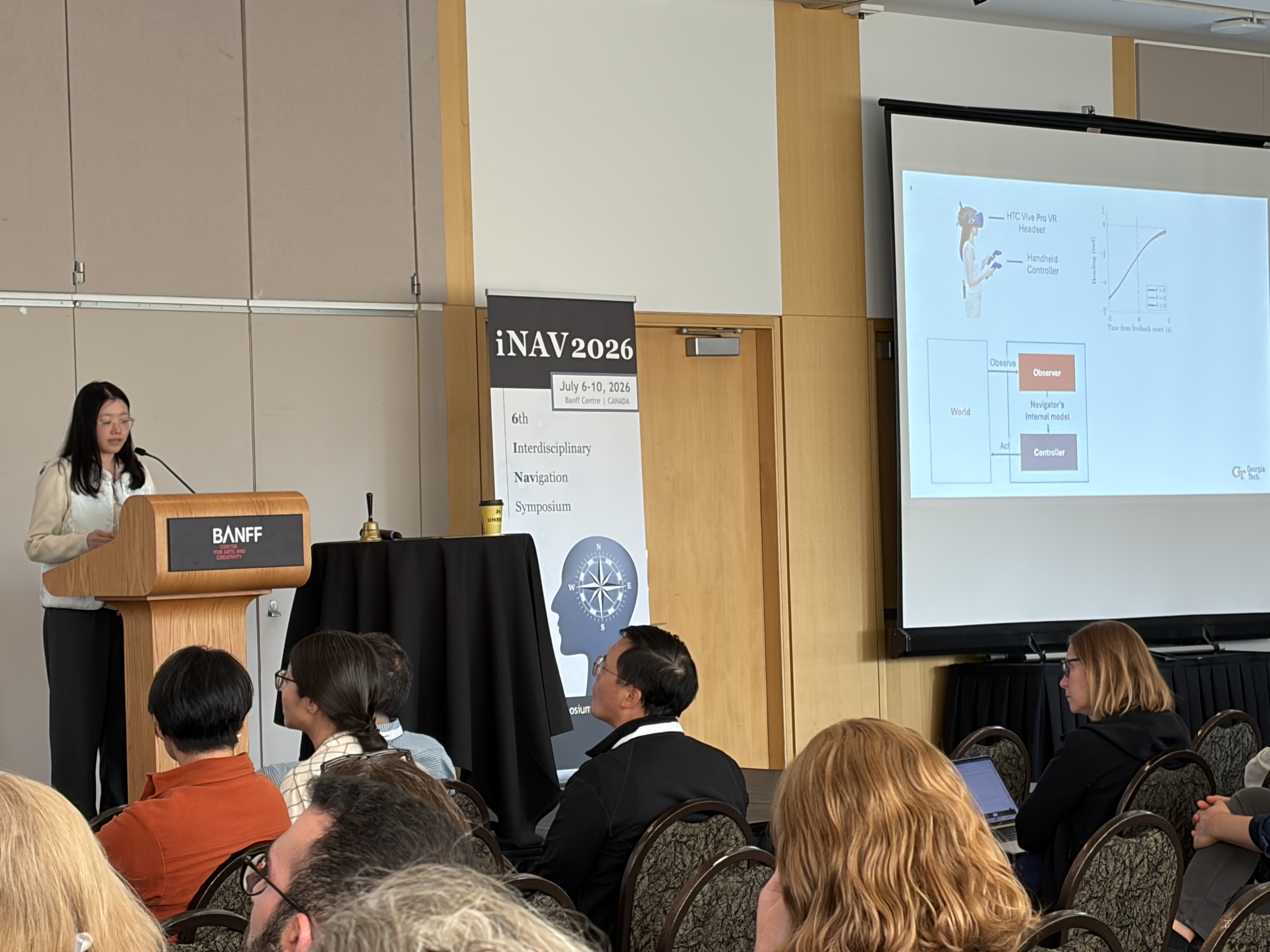
Oral presentation at the Interdisciplinary Navigation Symposium in Banff.
Teaching
 |
Course: Engineering Psychology [30 students]
Instructor
|
2026 Fall |
 |
Course: Math of the Mind [16 students]
Teaching Assistant
|
2025 Fall |
 |
Course: Research Methods [30 students]
Teaching Assistant
|
2025 Summer |
 |
Course: Applied Experimental Psychology [40 students]
Lab Instructor
|
2025 Spring |
|
Course: General Psychology [150 students]
Teaching Assistant (Full Course) and Guest Lecturer (Memory)
|
2024 Fall |
 |
Course: Vestibular System [20 students]
Guest Lecturer
|
2023 Spring |
 |
Course: Drugs and the Brain [200 students]
Teaching Assistant (Full Course) and Guest Lecturer (Psychedelics)
|
2023 Spring |
 |
Course: Psychological Measurement and Statistics [200 students]
Teaching Assistant (Full Course) and Guest Lecturer (ANOVA)
|
2022 Fall |
Service and Outreach
|
Graduate Representative
Psychology, Georgia Institute of Technology
|
2024 - 2025 |
|
Graduate Representative
Psychology, University of Arizona
|
2022 - 2024 |
Membership
 |
Society for Neuroscience
|
 |
American Psychological Association
|